Key Takeaways
- 97% of Your Visitors Aren't Ready to Buy - Designing for Intent With Greg Merrilees
- Stop Winning Design Awards, Start Winning Customers - With Greg Merrilees
- Unscripted SEO with Greg Merrilees: The PDF Graveyard, the Hive Mind, and Why Your Homepage Is Lying to Your Visitors
- What 2,000 Websites Taught One Designer About Copy, Clarity, and the AI Sameness Trap
- Unscripted SEO Interview with Greg Merrilees
Summary
- Your website is a digital asset you own - social media is rented land. For a serious, established business, a website combined with lead magnets and an email list is the only ecosystem you truly control. And ChatGPT is actively reading your website to form answers about your brand, so giving it nothing is not an option.
- Intent determines everything. Cold traffic gets a lead magnet. Warm traffic gets a deeper trust-builder - a free video, a trial, a challenge. Hot traffic gets a stripped-down page with one clear action and no nav links. Serving the wrong CTA to the wrong temperature is the single biggest conversion mistake Greg sees.
- The most important element on any website is the copywriting - not the design, not the animations, not the video background. Clarity beats cleverness every single time. Count your ‘I/we’ vs. ‘you/your’ ratio. Position your business as the guide, not the hero.
- Design trends are almost always conversion killers. Parallax, immersive animation, video backgrounds - they distract visitors from the copy and slow the page down. A static website with strong copy will outconvert a visually impressive one the vast majority of the time.
- To stand out in a commoditized niche, mine your own reviews and testimonials for recurring themes, build individual case studies that tell a before-and-after story, and avoid generic claims like ‘we’re the best’ in favor of specific, verifiable differentiators.
- Interactive lead magnets dramatically outperform PDFs in 2026. Vibe-coded tools that give prospects an instant result - a score, a calculation, a recommendation - convert at a far higher rate than static downloads that end up in the PDF graveyard.
- AI-generated websites and copy all look and feel the same. Google rewards brand signals and branded differentiation. If you use the same tools and prompts as your competitors without a strong design and brand strategy behind you, you produce the same output as everyone else - and that’s not a strategy, it’s noise.
Jeremy Rivera: Hello, I’m Jeremy Rivera, on the Unscripted SEO podcast by Permacast Walls. I’m here with Greg Merrilees, who’s going to introduce himself. And as usual, I’m going to ask him why we should trust him.
Greg Merrilees: Well, yeah - Greg Merrilees here. Founder of Studio1 Design. We’re a website agency. We do conversion optimization, we do branding, and we do website design. We have a dev team as well, but we’re mainly a design business. I’ve had my business since the year 2000, but we’ve been doing websites for about 15 years now. And we’ve designed for literally over 2,000 small businesses, medium-sized businesses.
We’ve even designed for some Hollywood A-listers like Gary Goldstein - the director of Pretty Woman - and Sylvester Stallone, which is pretty awesome. So why should you trust us? I only trust us if you follow us and you love our content and you have a look at our folio and you see the results that we get for similar businesses and then reach out. Then you can decide if you trust us or not.
Best Quotes from This Episode
“The most important thing on your website is actually the copywriting - and this is coming from a designer.” - Greg Merrilees
“If you want a serious business, you have to build an email list. And to do that, you need lead magnets. And to do that, you need a website - and a whole ecosystem of funnels off the back of your website.” - Greg Merrilees
“Clarity trumps everything else. It has to be clear: here’s what we do, here’s why you should choose us, here’s how you’re going to benefit.” - Greg Merrilees
Greg’s Background: From T-Shirt Factory to 2,000 Websites
Jeremy Rivera: Give me a little bit of your personal history. Where are you coming from? Were you in the graphic design game? Did you come at it from marketing - or were you wrestling alligators in the outback before you decided you should come in and make some websites instead?
Greg Merrilees: I’m actually a graphic design dropout. I went to university for that, but didn’t enjoy it. At the time I was working part-time, and then it turned into a full-time gig in a T-shirt factory where I designed T-shirts - and absolutely loved it. I was there for ten years until my boss had a brain aneurysm and died, unfortunately. From there, two of his clients wanted me to work for them, still doing T-shirts in the clothing industry. I couldn’t decide, so I started my own business.
Both of them said yes, they’d be my clients. So from there, we designed T-shirts and it turned into point-of-sale and branding and all these things to do with consumer products for about another decade - until the clothing industry went vertical.
Greg Merrilees: Our clients who were the wholesalers were getting squeezed out by their clients - the retailers - because retailers went directly to China themselves. So all of a sudden I had an office full of … we had six full-time graphic designers at the time and we were going down big time.
I borrowed a lot of money just to stay afloat. And then I found podcasts.
There was one podcast in particular with two hosts, James Franco and Ezra Firestone. It was called
Greg Merrilees: And then I found podcasts - one in particular with James Franco and Ezra Firestone. They said their logo sucked and I saw that as an opportunity to design them a logo for free to say thanks for their awesome content.
That turned into a relationship and we kicked off from there.
Jeremy Rivera: I love the concept of a barter. When I was starting in SEO, one of my first SEO gigs was trading - doing SEO and optimization to get my tailor in Riverside ranked number one, and he would give me a custom-tailored suit, which I wore for my wedding a couple of years later. He got the better deal because the suit doesn’t fit - but he still ranks number one.
Do You Even Need a Website Anymore?
Jeremy Rivera: Controversial - I’ve heard some people say it. Why do we even need websites? We’ve got social media sites now, so do I really have to bother with building a whole website?
Greg Merrilees: Yeah, it depends on your business model. If you’re just starting out, you probably could vibe code a website and get away with it - just do some things on social media to drive leads to the website. If at all - you may not even need a website, depending on the business model.
You could potentially just get people to book a call with you or buy your stuff off TikTok Shop or whatever. There are heaps of different business models. But if you’re a serious business - let’s say you’ve had a business for ten years, you’re either an online coach, a service business, an e-commerce business - you’ve built a brand and a reputation over that time.
You’ve probably also built a lot of SEO equity. But not just SEO equity - you’ve probably built brand equity in the marketplace.
Greg Merrilees: So if you just decide to put everything on social media, well, that’s kind of renting. You don’t own that asset. And if you really want a serious business, you have to build an email list.
And to do that, you need lead magnets.
To do that, you need a website.
A whole ecosystem of funnels off the back of your website to drive that traffic into somebody that’s going to trust you and reach out when they’re ready to buy from you.
Jeremy Rivera: And to point out - Matt Brooks of SEOteric, my friend, says ChatGPT is your least trained but most popular customer support representative. And ChatGPT is checking the SERPs and looking at your website for information about you.
So you’ve got to have somewhere to put more information out, right?
Greg Merrilees: Yeah, I couldn’t agree more. And I’ve listened to a dozen of your podcast episodes and you have a hell of a lot of knowledge in the SEO field. SEO is not dead - I don’t know why people keep saying that - because obviously AI gets all its information from Google and the search engines.
I see that a lot of businesses are getting less traffic because of the LLM answers, but you still need to put content on your own website to give it a chance. If anything, amp that up and you’ll keep getting great results.
But the thing that’s shifted is that you do have to do more social media - YouTube, LinkedIn, anything - to bring traffic to your website, other than just relying on SEO these days.
Understanding Searcher Intent
Jeremy Rivera: One of the points ChrisTweeten - he does Calgary SEO - was pointing out that one of the problems people aren’t taking into account with their content and the way they approach their site is understanding the intent of the searcher and understanding the intent of somebody that might be discovering it.
What do you bring to the table in that analysis when you’re discussing building out a site for a new company?
Greg Merrilees: Yeah, exactly. Intent is everything - because it’s pointless taking people to a website and expecting them to buy. 97% of people are just not ready. So what is their intent when they come to your website?
Which page did they come via - was it a bit of content, a podcast, a blog post? Was it one of your landing pages? If it’s e-commerce, was it a category page, a product page, or the homepage?
You have to think about their intent, whichever page they came in on, and think: what is the most logical next step for them?
Greg Merrilees: We say there are three different levels of intent as a general bucket: cold, warm, and hot.
Cold Traffic
Greg Merrilees: If they’re cold and they’re coming through a content page, you don’t want to offer a sales call for your service business or a coach or whatever. You just want to give them something of value in return for an email address to get them onto your list and into your ecosystem.
So if you have a look at a lot of blog posts - they really need a lot of work. What we do is put lead magnets inside the content.
On desktop we have a quick-links navigation on the left side and on the other side a sticky call to action, which is generally a lead magnet. We generally put some social proof on that page as well.
And at the very bottom, if they get all the way down, you might offer a second lead magnet.
Warm Traffic
Greg Merrilees: Warm traffic is for people who may already be on your email list or have been following your content on social media and YouTube - they trust you a little bit more.
So sure, offer the cold lead magnet - but also offer something for warm leads where they can invest a little bit more of their time.
It might be a free video, a free trial, a ten-step challenge, or just something that’s going to take a little bit more of their time. Because that builds more trust, and they’re more likely to take action if they’ve already built that warm rapport with you over time.
Hot Traffic
Greg Merrilees: For hot leads, you don’t want to take them through a funnel. You just want to say: buy my stuff. But you can’t do that on the homepage, right? So on the homepage is generally a gateway to get to all of your different offers, your lead magnets, your content.
On there, you might segment - have different offers, a little intro for cold, warm, and hot. But then I would also say you want to have a page specifically for people to buy - whether that’s a product or just ‘book a call.’ That’s for a hot lead.
You don’t generally get people booking calls if they’re cold or warm.
On that type of page, that’s where you really want social proof, no navigation links, and just give them that one thing to do.
Jeremy Rivera: I love that perspective. I worked on a very large subcontract at an agency - they did PCB design - and there was a whole lot of thought we put into a huge content library, always conscious of how far down the conversion funnel somebody reading this might be.
Is this somebody who’s actively designing?
Is this somebody who might be looking to use the software?
Or are we supporting somebody who already has our software and needs the latest info?
A lot of people don’t take the time to diagnose or think about their website other than: you’re here, I’m going to hit you with a stick.
Analytics: Microsoft Clarity and the Tools You Should Be Using
Greg Merrilees: I think a lot of people don’t look at their analytics, even Google Analytics, you know? There’s a free tool called Microsoft Clarity that I think every website should have. It’s amazing. We used to use Hotjar - which is not free - and to be honest, we found it did actually slow down the website a bit. Microsoft Clarity doesn’t slow down the website.
It has heat maps, it has user recordings - video recordings of everybody that’s on your website. It also has some AI built into it to give you recommendations and observations.
So I think everybody should put Microsoft Clarity on their website and just review it once a month at a minimum.
Greg Merrilees: Also look at your Google Analytics and you can pair it up and see the pathways people come in, where they exit your website. Then you can hypothesize - which is just a fancy word for saying work out what you think you could test next.
And that’s when you can either do A/B split testing with some software like VWO, which is what we use, or you can test over time.
If you don’t have a lot of traffic - because you really need at least a thousand visitors per test, per page - you can test over time.
Make some changes, see how it converts, then compare to the previous same time period.
Jeremy Rivera: I can’t really blame people for not wanting to use Google Analytics because they’ve literally turned it into a torture device. Fortunately, my friend Matt Mellinger made SEO Gets, which integrates with Search Console - but he just released integration for Google Analytics data at his paid level, so it pulls in GA data into an actually usable interface and surfaces it alongside Google Search Console data.
That’s always been the dream. I spent so much time in what was Looker Studio trying to make these templates - it’s just so convoluted and difficult. So anybody listening, go check out SEO Gets.
It also has content grouping, which is technically in Google Analytics, but it takes a very savvy GA person to properly execute on content grouping. So that’s super handy. A pro tip right there.
Greg Merrilees: Thanks for that tip - I didn’t even know about that tool. I’ll check it out.
Website Design Trends: Stop Chasing Them
Jeremy Rivera: Thinking back - when I first created my first website it was on GeoCities. There was a spinning flaming skull in the background and a MIDI playing as soon as you landed on the page. It was awesome. Then I started using WordPress sites, cut them up in Dreamweaver.
And then people wanted parallax websites - 2015 to 2020, everything had to have parallax. What is the du jour of web design right now?
What are people saying ‘my website needs to be able to do this’ about?
Greg Merrilees: Every year I used to put out content around website design trends. Now over the years there’s been less and less new trends. And this year I did a video on ‘do not follow design trends’ because nothing’s changed, right? The problem is designers get bored.
So they want to keep coming up with new trends - but the problem with the majority of these trends, like the parallax effects, immersive design, all these things that have animation and things flying in as you scroll down the page - they don’t convert. They just distract people.
You can see the full breakdown in Studio1’s post: Don’t Chase Website Design Trends in 2026.
Greg Merrilees: And so the most important thing on your website is actually the copywriting - and this is coming from a designer, right?
Jeremy Rivera: … You’re going to get quoted on that.
Greg Merrilees: Yeah. And the copywriting needs to talk to them in a way that lets them know you have a solution to their problem. What’s unique about you? Why should they choose you over your competitors?
And do you have proof to back it up? These immersive designs with all the parallax, crazy animation, and video backgrounds - video backgrounds are the biggest conversion killer - because A, they slow down the website, and B, they completely take your eyes off the copywriting. And not only that - just on video backgrounds specifically - I have a bug bear with them
. If you’ve got a repeat visitor coming to your website and they see the same video loop going again and again, they’re so annoyed. You might think it’s cool, and you’ll probably win a design award with that fancy website - but have a look at your conversions. 90% of the time it won’t convert as well as a static website with a little bit of movement.
A little bit of parallax is fine - but yeah, I wouldn’t copy those design trends anymore. The data is in The Hidden Cost of Fancy Website Effects: Lost Conversions.
Copywriting & Positioning: Why Most Websites Are About the Wrong Person
Jeremy Rivera: I can now quote you and say copy is more important than design. Talk about some of the decisions - because I’ve done so many website audits and seen: why did you choose to write this?
You say you do brand redesigns for restaurants, but your website looks like you’re just a restaurant. ‘We’re the best. We’ve got the best customer service. We’ll get results done quickly.’
What results?
What is it about the sales mentality that is so opposed to literally saying what it is that you do?
Greg Merrilees: I have no idea - and they’re going to lose every time, because clarity trumps everything else.
It has to be clear: here’s what we do, here’s why you should choose us, here’s how you’re going to benefit.
That’s absolutely crucial.
You want copy that appeals for SEO so it ranks well, but it also needs to have some benefit in the main headline: here’s what we do and here’s how it’s going to help you.
Greg Merrilees: I love the book Building a StoryBrand by Donald Miller - where you’re meant to position your business as the guide and your prospects and clients as the hero.
Every bit of wording on your website needs to reflect that.
So here’s a simple thing anybody can do on their own website: count how many times you use the words ‘I’ or ‘we’ versus how many times you use ‘you’ or ‘your.’ If you’re using more ‘I’ or ‘we’ - it’s more about you, and it needs to be flipped to be more about how you can help them.
Jeremy Rivera: I literally just had my wife ask me: what is first person versus second person versus third person writing?
Second person is where you’re putting somebody into the narrative and speaking to them - you could, you should, you’d.
Be using that a lot in your copy, particularly on service pages.
Standing Out in Commoditized Local Markets
Jeremy Rivera: I’m curious - when it comes to local service businesses, lawyers, construction, remodeling - they’re kind of commoditized. How do you approach making those unique?
Because the difference between a Realtor in Cookeville and a Realtor in Nashville - you sell the home the same way.
What do you focus on in that creation process to draw something unique out of them?
Greg Merrilees: It’s a great question. It takes a lot. It’s what we call brand positioning. To find out what that uniqueness is, there are a whole bunch of ways to go about it. One might be - first up, we do quite a few lawyer websites.
One of them is Yosha Law, if anybody wants to check it out, based in Indiana. Most of our clients are in the US, even though I have an Australian accent. So what we did with them was: we got a copywriter to interview them and interview their clients to try to figure out why their clients choose them over their competitors.
Greg Merrilees: But apart from that, anybody can look at the testimonials or reviews of their business, put them into ChatGPT, and you’ll find some recurring themes about what people say about you. Because not many businesses know themselves what is unique about them.
With lawyers - there’s always the ‘no win, no fee’ stuff. But it might also be the people behind the brand, the experience they’ve got, maybe they’ve been in business for fifty years. On top of that, look at their results. Some lawyers just have impact metrics saying ‘we’ve got a billion dollars in recovery.’
But if you look at individual case studies - and most law firms don’t have these on their website - then you can tell the story behind that result.
Greg Merrilees: Here’s this person’s situation before they came to us. The insurance offered them $50,000 after a car accident. We went and saw them. We have a video for this - it’s a really good video on Yosha Law’s website - to get that emotional hook in the video. And then you talk about the results you helped them achieve. Don’t just have a headline.
Let people know what is unique about you - it comes out of the copywriting process and the reviews. And have a section on your website that talks about what is unique about you. Don’t say ‘we’re the best.’ Just talk about whatever that uniqueness is. It is hard to find, but you can find it. It’s in there somewhere.
**More on how this played out for a law firm in Studio1’s post: How We Turned a Law Firm Redesign Into 60% More Conversions.
Lead Magnets in 2026: Interactive Tools Beat PDF Downloads
Jeremy Rivera: Lead magnets is the phrase you dropped earlier. Tell me what are lead magnets in this day and age? I have an idea, but I’d love to hear your raw take.
Greg Merrilees: Absolutely. So we do a lot of vibe coding for lead magnets these days - because gone are the days where people just want to download a PDF and put it in the PDF graveyard, because they’ll never get to it. Even though we still do that, and they do still convert reasonably well - however, people want quick results. So these days you can vibe code - we use Cursor, and I think even ChatGPT can do some basic vibe coding these days - and what we’re trying to do is give people a quick result.
So you have an interactive type of lead magnet that asks them a whole bunch of questions and gives them a score or a result based on that, instantly. Just as one example, there’s a website Enterprise Fitness - a personal training business - and we did a macro calculator for their prospects to figure out how many macros of the three things they need each day to meet their targets.
That has just been an incredible lead magnet for them. Before that, they had a free excerpt from a book and another PDF download, but none of them converted anywhere near as well. You can see how Studio1 applied this principle to drive 64% more fitness bookings here.
Jeremy Rivera: I like that because in 2015 something like that would have been out of reach for anyone other than a very large brand or budget - they could assign a skilled developer to come up with even a basic interactive widget. So taking advantage of that now, I love that concept.
Greg Merrilees: Yep, exactly. And the websites we build these days - they’re on WordPress. So we haven’t vibe coded and then left it. Our developers skin it as per our custom design, so they look completely custom - and they are. You can see the design approach Studio1 used to hit 82% more membership sales in this case study.
Greg’s Soapbox: Vibe-Coded Websites Are Ruining Brands
Jeremy Rivera: Let’s break out the soapbox. I’m going to put it in front of you. You choose the people: potential clients, internet users in general, or fellow website builders.
What’s been something you’re passionate about that you want to get off your chest?
Greg Merrilees: Small businesses, yeah, in general. Look - obviously we do website design and that’s how we make our money. But these days - sure, you can use vibe coding. But I believe that if you vibe code a website it will negatively affect your brand.
Now, you don’t need to go fully custom like a service like ours.
But just think - because if you have a look at any vibe-coded website, to me they all look the same. They all look super boring. I follow a lot of AI experts on YouTube and there’s so much content about how vibe coding is the next thing for websites.
And honestly - we’re using vibe coding in a way to try and turn our Figma custom designs into coded WordPress or Webflow or Shopify pages, but it’s not easy. It still requires a proper developer to get in there and tweak things.
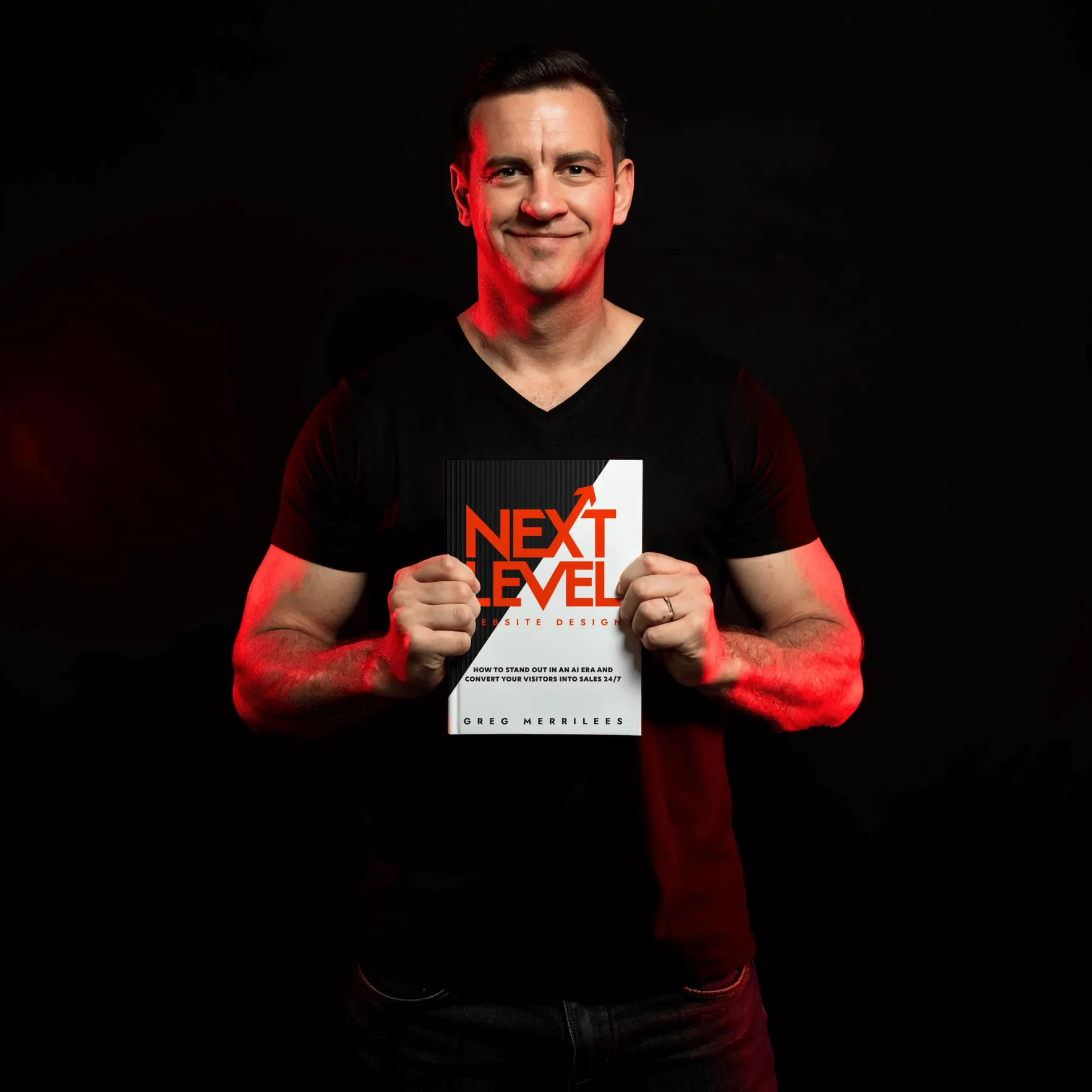
Just be careful - because I feel like it will ruin your reputation if you just get a vibe-coded website without putting a lot of design behind it. I have a book: Next Level Website Design. If you go to nextlevelwebsitedesign.com/free, there’s a free resources tab.
I’ve got my entire book uploaded to a custom GPT, plus a whole bunch of other free resources - book companion and more. If you use that custom GPT you can ask it anything to help you create sections for your website.
It’ll give you a pretty good blueprint to hand to another designer if you want.
The AI Sameness Problem: A Stanford Study and a Snake Eating Its Own Tail
Jeremy Rivera: I can give you backup from Stanford University. They did a study that showed that even with three or four specific prompts that are supposed to spark diverse, creative, different answers - what they found is that all of the major chat models returned a tyranny of sameness.
They made the same cultural references, referenced the same materials, and produced uniform answers. A hive-mind mentality emerged from the creative process - when if any human actually answered those prompts, which are specifically designed to spark creativity - they would differ vastly.
And that is one of the flaws of trying to use a tool based off prediction and mathematics for creative purposes. It can only be as creative as its baseline training material.
Jeremy Rivera: Which at this point - there is no new material. Everything before 2015 is the pure research training data set. Everything after that - and I don’t know if many people realize this - LLM tools have been used at large scale by marketing companies and others since 2015
. So since then, LLMs have been kind of polluting the internet with more and more sameness and more repetition. And especially in the past three years with the huge popularity explosion of ChatGPT, that snake eating its own tail effect is starting to take hold - where you’re just getting the same factoid republished in this article, then that gets crawled and republished, and then part of what gets cited.
So just be aware: there isn’t a magic creative button behind the scenes. Anybody who is working in digital marketing should take the time to read Wolfram Alpha’s breakdown of how ChatGPT actually works as a model - to see that it is literally just predicting the next word in the sentence every single time.
It is like a parrot squawking.
It is not speaking English
. It is speaking math.
Greg Merrilees: And the thing that annoys me is that people can’t see the patterns that ChatGPT is producing in their video scripts or their emails. There are so many patterns - there’s always a section in there: ‘it’s not this, it’s not this, but it’s that.’
Look for that pattern - you’ll hear it all the time now that I’ve mentioned it.
It’s a dead giveaway. And I’m surprised that humans can’t see that pattern and stop using it - or at least edit the content to get rid of things that are so obviously ChatGPT.
Greg Merrilees: Apart from that - I don’t know why LLMs can’t design well yet. Don’t get me wrong, they can do graphics and ads and some basic stuff, but they can’t do unique custom design.
And I think it comes back to your point: it’s the snake eating its own tail - just regurgitating stuff and getting worse over time. I believe there’s always going to be room for a decent design business to have decent-level clients
. Maybe the bottom of the market will drop off, but there are always going to be brands that need proper custom branding.
**The full picture on what this means for websites is in Studio1’s post: AI Killed Your Website Strategy: Here’s What Works Now.
Jeremy Rivera: Branding is the key. Google itself has, in the past few years, turned up the screws on the requirements for those signals to exist that you are a brand - both in terms of on your site and references in third-party sources.
You can’t rely on just getting links. You need links that represent your brand. You need branded anchor text to match the content that you have. So on the SEO side, that’s equally true.
And in order to stand out - yeah, you’ve got to have more than just the next guy’s weapon. Everybody can get a $20 subscription to Claude or ChatGPT. So if you are going at that basic level, you don’t want to do the same as what your competitor is doing. And that’s exactly what these LLM tools are going to produce.
Greg Merrilees: Yeah, so true. Any niche now - if you look at an LLM website, you can spot them a mile away. There really is no differentiator. So just be careful: you ruin your brand unless you really think about it properly and try not to be like anybody else in your niche.
Conclusion
A website that converts isn't about having the latest design features or the most impressive animations. It's about understanding who's visiting, meeting them where they are, and making it easy for them to take the next logical step.
The principles that come up again and again across thousands of projects tend to be the same: clarity in what you say, structure in how you present it, and genuine value in what you offer. Those things don't change much regardless of what's happening with technology or trends.
If you're wondering how these ideas might apply to your specific situation, book a strategy conversation with Greg Merrilees to talk through what's working, what isn't, and discover how to boost your conversions, position your brand better, discuss strategy, lead magnets, and funnels to help drive more leads and sales in your business.